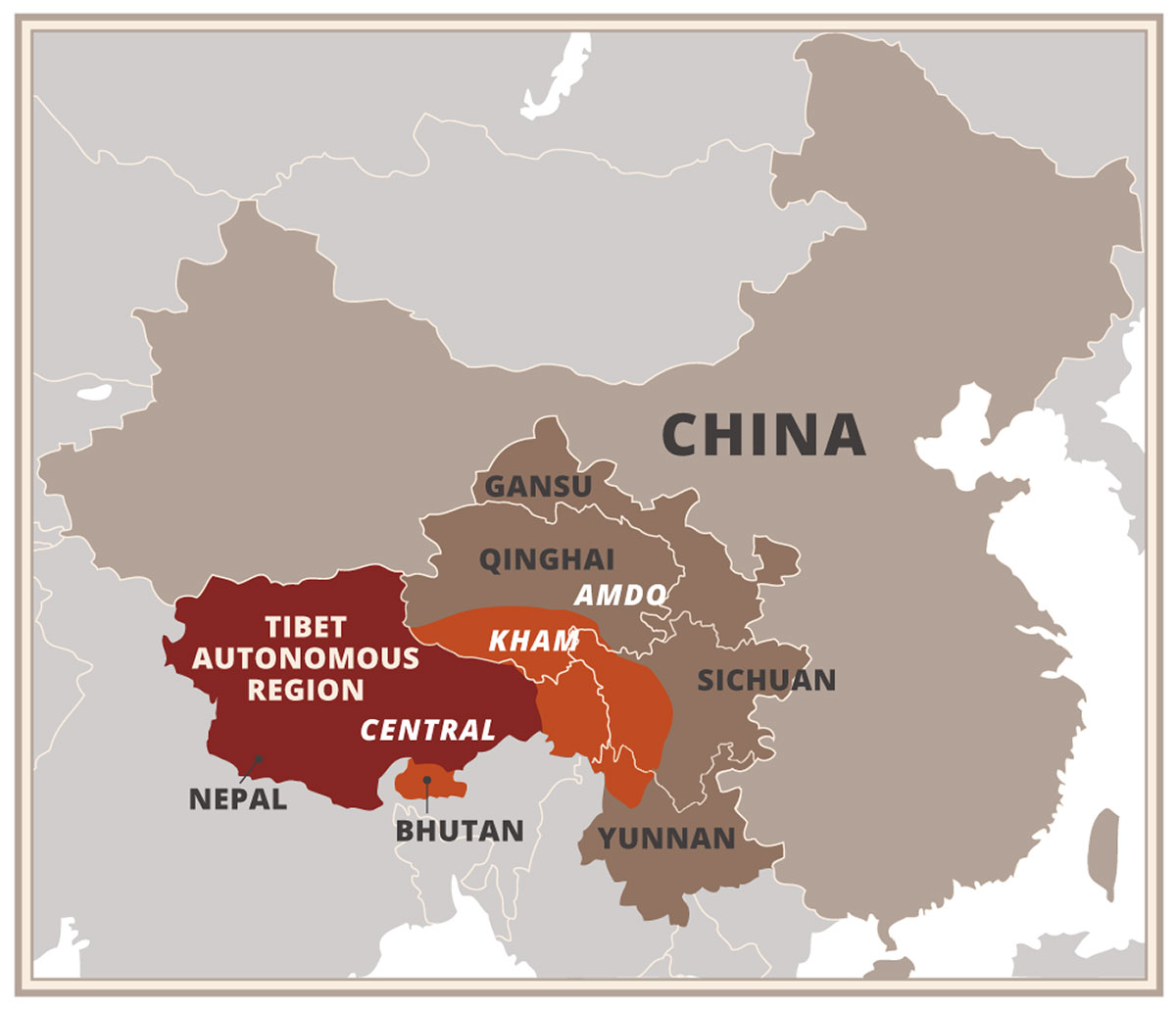
When people hear “Tibet,” they often think of the Tibet Autonomous Region (TAR) on China’s far western plateau. But culturally and historically, the Tibetan world extends far beyond that political boundary. What Tibetans call Bod Yul — the Land of Tibet — traditionally includes not only today’s TAR, but also large parts of Qinghai, western Sichuan, southern Gansu, and northern Yunnan provinces.
Altogether, this vast region covers an area of more than 2.5 million square kilometers — nearly one-quarter of China’s total landmass — yet it is home to only around 7 to 8 million Tibetans, less than 0.5% of China’s population. The sheer contrast between its size and its population reflects the region’s high altitude, rugged terrain, and harsh living conditions.
The Three Traditional Regions: Ü-Tsang, Kham, and Amdo
For centuries, Tibetans themselves have divided their homeland into three great cultural regions, known as Ü-Tsang (དབུས་གཙང་), Kham (ཁམས་), and Amdo (ཨ༌མདོ་).
These divisions were not drawn by modern politics, but rather by language and lifestyle. In fact, the dialects spoken in these three regions are often mutually unintelligible, people sometimes marry each other but have to communicate in mandarin or another language.
Ü-Tsang: The Spiritual Heartland
Ü-Tsang roughly corresponds to what is now the Tibet Autonomous Region, including Lhasa, Shigatse, and Gyantse. It is characterized by wide valleys, sacred mountains, and fertile river basins along the Yarlung Tsangpo (Brahmaputra) — Tibet’s lifeline.
It is often said that Ü-Tsang is the land of faith, where spirituality and monastic life dominate.
Kham: The Land of the People
To the east lies Kham, a dramatic land of deep gorges, snow-capped peaks, and fast rivers. It stretches across western Sichuan, northern Yunnan, and parts of eastern Tibet.
Kham people are famous for their strong physique, independence, and striking appearance, giving rise to a local saying that Kham is the land of people. Historically, the Khampa were renowned horsemen and traders who lived in small kingdoms and chiefdoms, forming a frontier between central Tibet and China’s western provinces.
Culturally, Kham Tibetans have their own distinct dress, architecture, and dialect, and their monasteries often blend influences from Tibetan, Chinese and yunnan minority traditions.
Amdo: The Land of Horses and Herders
To the northeast lies Amdo, covering much of Qinghai Province and parts of Gansu and northern Sichuan.
Amdo’s beautiful grasslands are home to nomadic herders who raise yaks and horses. Many of Tibet’s greatest scholars, including the 14th Dalai Lama, were born in Amdo.
Because of its vast pastures and open sky, Amdo is remembered as the land of horses.
The Outer Realms of Tibetan Culture: Bhutan, Ladakh, and Beyond

If we look beyond modern borders, Tibetan civilization historically extended far wider than the realm of China. Bhutan, Ladakh and Sikkim seem to share similar language and culture as tibetans.
Scholars today often call this space the “Tibetan cultural sphere” (or ethnographic Tibet) — meaning all areas where Tibetan language, Buddhism, art, and social customs formed the backbone of local identity.
This includes: Ladakh, Mustang, Dolpo, Sikkim, Bhutan, parts of Arunachal Pradesh, and Spiti / Kinnaur in northern India.
Why these regions are culturally "tibetan"
Historically, many of these areas were part of the Tibetan Empire (7th–9th centuries) under Songtsen Gampo, Trisong Detsen, and Ralpachen.
When the empire later fragmented, local principalities and monasteries continued to share
- the Tibetan script and literary language
- Tibetan Buddhism, particularly the Nyingma, Kagyu, Sakya, and later Gelug schools.
- And a shared worldview built around the highland environment and the concept of Bod yul — the land of Bod.
Even after they became independent kingdoms (like Bhutan and Sikkim), they kept this cultural base.
How Tibetans themselves thinks what counts as "tibetan"
Did the Tibetans themselves see these areas as “Bo” — part of their land and people?
Tibetans from Ü-Tsang (the heart around Lhasa) generally saw Kham and Amdo as parts of Bod-yul, though sometimes with a sense of “frontier regions.”
The expression Bod chen po (བོད་ཆེན་པོ་) — Greater Tibet or the great land of Bod — was sometimes used to describe all of them together.
Toward the periphery
Regions like Ladakh, Mustang, Sikkim, Bhutan, and Spiti were recognized as “Tibetan-speaking Buddhist kingdoms”, sharing ancestry and religion with central Tibet — but they were also seen as “yul khor” (ཡུལ་འཁོར་) — literally surrounding lands.
That means: culturally part of the same world, but politically and ethnically somewhat distinct.
A Tibetan scholar or lama from Lhasa would not call Bhutanese or Ladakhi people “foreigners,” but rather “brother peoples” (mched brgyud) within the Bod civilization.
Yet at the same time, Bhutanese and Ladakhis developed their own kings and monastic hierarchies, so they called themselves “Drukpa” (Bhutan) or “Ladakhpa”, even while recognizing that their script, language, and Buddhism came from Bod.
So in identity terms:
They might NOT say “We are Bo-pa,”
but they would say “We come from the tradition of Bod.”
Specific regional notes
|
Region
|
Tibetan cultural relation
|
How locals identify
|
Notes
|
|
Bhutan (འབྲུག་ Druk)
|
Deeply Tibetan Buddhist (Drukpa Kagyu lineage); script and language from Old Tibetan
|
Identify as Drukpa, not Bo-pa
|
Formerly under Tibetan clerical influence but became independent in 17th c.
|
|
Sikkim (འབྲས་ལྗོངས་ Dremjong)
|
Nyingma-Kagyu Tibetan Buddhism, Tibetan script
|
Identify as Lho Monjongpa, later Sikkimese
|
Ruled by a dynasty descended from Khampa Tibetans
|
|
Mustang (སྨུས་ཐང་)
|
Tibetan-speaking, same religion and architecture
|
Identify as Lo-pa
|
Culturally Tibetan; politically part of Nepal
|
|
Ladakh (ལ་དྭགས་)
|
Western Tibetan dialect, Buddhism, architecture
|
Identify as Ladakhpa
|
Was an independent kingdom often allied with or tributary to Tibet
|
|
Spiti / Kinnaur / Tawang / Arunachal
|
Tibetan Buddhist monasteries, Tibetan liturgy
|
Mix of local and Tibetan identity
|
Still culturally Tibetan today
|
|
Amdo / Kham
|
Linguistically and ethnically Tibetan
|
Bo-pa
|
Always considered part of Tibet by Tibetans themselves
|
In Tibetan understanding: concentric worlds
Traditional Tibetan cosmology and politics viewed the world in rings of relatedness:
1. The sacred center — Ü-Tsang, the land of the Dalai Lama and Lhasa.
2. The outer regions — Kham and Amdo, Tibetan but regionally distinct.
3. The surrounding lands — Ladakh, Bhutan, Mustang, Sikkim, etc., linked through religion and language.
4. The foreign lands — China, Mongolia, Nepal, India — culturally different worlds.




0 comments